PDF Print E-mail


So, what makes our service different compared to all other competitors?


Before we get into details, let's examine some global plagiarism statistics:

  • A study by The Center for Academic Integrity found that almost 80% of college students admit to cheating at least once.”
  • ”A survey by the Psychological Record shows that 36% of undergraduates have admitted to plagiarizing written material.”
  • ”A poll conducted by US News and World Reports found that 90% of students believe that cheaters are either never caught or have never been appropriately disciplined.”
  • ”A study conducted by Ronald M. Aaron and Robert T. Georgia: Administrator Perceptions of Student Academic Dishonesty in Collegiate Institutions found that 257 chief student affairs officers across the country believe that colleges and universities have not addressed the cheating problem adequately.”
  • ”According to the Gallup Organization (October 6-9, 2000), the top two problems facing the United States are: 1) Education and 2) Decline in Ethics (both were ranked over crime, poverty, drugs, taxes, guns, environment, and racism, to name a few).”
  • ”A national survey published in Education Week found that 54% of students admitted to plagiarizing from the Internet; 74% of students admitted that at least once during the past school year they had engaged in "serious" cheating; and 47% of students believe their teachers sometimes choose to ignore students who are cheating.”
Conventional methods of plagiarism detection:

Even though many instructors are aware of the problems of plagiarism, they feel powerless or are simply unwilling to address it. TechWeb News published an article from a Stanford University professor who admitted that instructors are aware of students plagiarizing their work but are unwilling to investigate the matter, according to him; few are willing to search through the vast expanse of the Internet to hunt down suspect work.

To address this problem various tools were developed during the late 90’s. Software, such as “Plagiarism-Finder” (M4-Software), “EVE2” (Canexus), “YAP” (University of Sydney), “SCAM” (Stanford University) are the more prominent ones. The main drawback of these soft-wares is that they rely excessively on search engines to find suspect writing. A technique which is inherently flawed, since most search engines only account for just 16% of the billions of websites making up the Internet today. Another facet which exploits this approach is the use of password-protected websites, the software cannot access such sites and thus the plagiarized work remains largely undetected.

To counter this, Universities started developing and populating their own databases of copyrighted and published papers against which the soft-wares were modified to work. This too proved insufficient since cheating software has concurrently evolved, mainly taking the form of ‘automatic paraphrasing’, whereby thesauruses are utilized to change words and sentence structures to avoid detection by conventional soft-wares which reply on string-matching to catch suspect sentences. To address this, a more robust and comprehensive approach was needed.

New technique to combat plagiarism: CheckForPlagiarism.net - Patented Plagiarism Checking Service

In 2004, a group of teachers, mathematicians, scientists, and programmers formed Plagiarism-Checkers, Inc. They started working on a new technology, “Document Source Analysis” implemented at www.CheckForPlagiarism.net. Now in it’s fourth year of development, the technology works on innovative and powerful algorithms which create a digital fingerprint of any text document. It operates in a series of steps:

  1. The software starts out by digitally recognizing the structure of any submitted documents; the sentences and paragraphs are mapped using a set of specially developed algorithms.
  2. This fingerprint is cross-referenced against a database of billions of papers collected from major universities and paper-mills worldwide.
  3. The fingerprint is simultaneously sent to crawlers who scour the World Wide Web for possible matches.
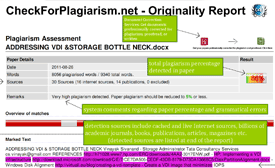
  4. Finally, an originality report is compiled, complete with color coding, giving sources of matching links.


The copyrighted fingerprinting technology was developed to combat the most creative attempts of plagiarism. Its strength lies in its ability to rank papers on not just string matching or sentence structure but also on a percentage of synonyms used against a suspect source. The technology service employs its own thesauruses on submitted papers and matches them against published material or sources in its own vast database and the Internet.

To exhibit and understand the methodology of document fingerprinting, consider the following hypothetical case (sourced from Google). The first paper, (Paper A), is an excerpt of an Internet derived paper, the introductory paragraph of Macbeth. The second, (Paper B), is a submitted paper, using added text, being tested for plagiarism. While the third (Paper C) is the same paragraph with extensive synonyms used. The modified and added content in Paper B and Paper C are highlighted in different shades of red.

“Paper A (original)”

“Macbeth is presented as a mature man of definitely established character, successful in certain fields of activity and enjoying an enviable reputation. We must not conclude, there, that all his volitions and actions are predictable; Macbeth's character, like any other man's at a given moment, is what is being made out of potentialities plus environment, and no one, not even Macbeth himself, can know all his inordinate self-love whose actions are discovered to be-and no doubt have been for a long time-determined mainly by an inordinate desire for some temporal or mutable good.


“Paper B (added text)”

“Shakespeare's famous play, Macbeth, is one of his great tragedies based around the classic theme of the hero's fatal flaw. Macbeth is presented as a mature man of definitely established character, successful in certain fields of activity and enjoying an enviable reputation. Yet, like any man, he is human, and thus in possession of flaw and foibles, hidden that they may be from public eye, and hinted at by foreshadow only by the author. We must not conclude, there, that all his volition's and actions are predictable; Macbeth's character, like any other man's at a given moment, is what is being made out of potentialities plus environment, and no one, not even Macbeth himself, can know all his inordinate self-love whose actions are discovered to be-and no doubt have been for a long time- determined mainly by an inordinate desire for some temporal or mutable good. This desire being so strong under certain circumstances as to override all others, even, as is usually the case in tragedy, the ultimate desire of self-preservation.


“Paper C (modified text)”

“Macbeth is shown as an empowered man of well-established character, prosperous in several fields of life and enjoying an esteemed reputation. We mustn't conclude, therefore, that all of his volitions and actions will be foreseeable; Macbeth's essence, like most other men at any given time, is what's being created out of potentialities and his environment, and no one, not even Macbeth himself, can discern all his immoderate self-love whose behaviors are found to be-and without doubt have been for some time-determined primarily by an extreme desire for a temporal or changeable good.


Both instances (Papers B and C) of plagiarism were successfully caught through document fingerprinting techniques while the other soft-wares, making use of conventional detection techniques, were fooled. It is important to remember there is no definitive or guaranteed software or technique of detection out there which is absolutely fool-proof, but new creative innovations, driven by an intense concern due to plagiarism are making it harder for plagiarists to get away with cheating.

Implementation

Academic institutions and research houses around the globe have started implementing this new technique of detecting and rooting out plagiarism. Students and writers no longer submit their work directly to the instructor or publisher; instead, they submit it to these fingerprinting engines. The software in turn generates a report of its findings and makes it available to the instructor or other concerned authority.

Usage

The software works in an efficient new way (as mentioned above). Universities and academic institutions first have to license it, and then implement it. Next, instructors can submit documents online, while students are then required to submit using this software, by uploading it to the website. The software runs its unique algorithm on it, checks it from its vast database, as well as through the internet and makes the results available to the instructor with a comprehensive color-coded originality-report of the submitted document. This alteration over conventional document submission norm helps save time as well as arming the instructor with irrefutable proof of any plagiarism detected.

Promulgation of plagiarism:

Plagiarism has been in play since the genesis of organized education, thus the probability exists that there always will remain students or individuals who plagiarize. With the inception of the Internet, the promulgation of this form of cheating has exploded and has made it imperative for teachers and other facilitators to combat it effectively. Understanding what plagiarism is, how to prevent it, and devising innovative technologies to detect it can help detour this problem.

It must also be asserted that, no single software tool or technological-innovation will help deter this problem completely. Educationists as well as ethicists need to educate students and individuals on the amoral aspects of plagiarism. Having said this, one should exercise caution when suspecting or accusing anyone of plagiarism, innocent mistakes as well as genuine incidents of similar use may easily exist. Therefore, what should be investigated is repetitive behavior and patterns of deliberate deception.

So why should you consider our service? CheckForPlagiarism.net - Money Back Guarantee

CheckForPlagiarism.net is backed by a full money-back guarantee, that is how confident we are in the ability of our service and the strength of our plagiarism checking engine. Our service is currently in use by numerous educational institutes, US Military, as well as, a diverse range of professional concerns.

In addition to institutional accounts, we enjoy the confidence of over 10,000 individual accounts (including students, lawyers, doctors, educationists etc), who utilize our service on a daily basis. In conclusion, we'd simply like to say this, give us a risk-free trial today, we guarantee you won't be disappointed!


Back